
Antelope Valley driveways and parking lots
Asphalt Paving in Palmdale, CA
New asphalt on a compacted base, plus the sealcoating, crack filling and striping that keep it from drying out and breaking up in the high desert.
- Free on-site estimates
- Itemized written quote before work starts
- Base depth and asphalt thickness stated in writing
Asphalt Built for Desert Sun, Freezing Mornings and Wind
Asphalt paving in Palmdale has to hold up to a climate that swings hard in both directions. Palmdale's official weather station averages about 35 afternoons a year at 100 degrees or hotter, and about 52 mornings a year at or below freezing. The city's record high is 126 degrees, set on August 5, 1990, and its record low is 3 degrees. Rain is scarce, about 5.9 inches a year spread over roughly 27 days. That mix punishes pavement in a different way than a wet climate does. The sun dries the binder out, the cold nights open cracks, and the occasional heavy storm finds every edge that was never shaped to drain.
Sun is the slow enemy
Asphalt is stone held together by a petroleum binder. Ultraviolet light and heat oxidize that binder over time, and the surface turns from black to gray, loses its flexibility and starts to ravel, shedding small stones. In the Antelope Valley, where the sun is out most of the year, that happens faster than it would on the coast. A new driveway that is never sealed can look tired within a few seasons. Sealcoating puts a sacrificial layer between the sun and the binder, and it is the cheapest way to add years to a driveway or lot here.
Cold nights still crack pavement
People are often surprised that a desert city sees freezing weather on about 52 mornings a year. Palmdale sits at about 2,655 feet, and January's average low is just under 33 degrees. Water that gets into a crack freezes, expands and pushes the crack wider. Asphalt that was soft at 3 p.m. in July becomes brittle at 6 a.m. in January. Crack filling before winter, and a surface that sheds water instead of holding it, slows that cycle down.
The base decides how long it lasts
Most failures we see start below the asphalt. HomeGuide's cost guide describes a typical residential driveway as 2 to 3 inches of compacted asphalt over 6 to 8 inches of compacted gravel base, with 3 to 4 inches of asphalt for heavier vehicles and 4 inches or more for commercial lots. Desert soil can look firm when it is dry and still settle once it is soaked by a storm or a leaking irrigation line. On every job we check the subgrade, dig out soft areas, replace them with compacted aggregate and grade the base so water runs off rather than under the pavement.
Wind, sand and dust
Wind is part of daily life in the Antelope Valley, and it affects paving in two ways. Blowing sand settles on the base and on tack coat, which weakens the bond between layers, so we clean surfaces right before paving. And the Antelope Valley Air Quality Management District's Rule 403 limits dust from construction work: dust may not stay visible beyond the property line, and mud or dirt tracked onto a paved road has to be cleaned up by the end of the workday. We water dusty work and keep the street clean as part of the job.
Permits and the public right-of-way
The strip between the street and your property line belongs to the public. Palmdale's municipal code adopts the Los Angeles County highway permit ordinance as the city's own, with the city's Director of Public Works in charge of it. In unincorporated communities such as Quartz Hill, Sun Village or Lake Los Angeles, Los Angeles County Public Works issues road permits for driveway approaches, curbs and sidewalks. North of the county line, Kern County handles its own roads. If your project only covers your side of the property line, none of this may apply. If it touches the apron or the street, we tell you at the estimate which agency is involved and build that step into the schedule.
What a typical driveway job includes
- Measuring, checking slope and looking at the apron and garage slab
- Removing old asphalt, concrete or gravel and hauling it away
- Digging out soft subgrade and replacing it with compacted aggregate
- Grading and compacting the base
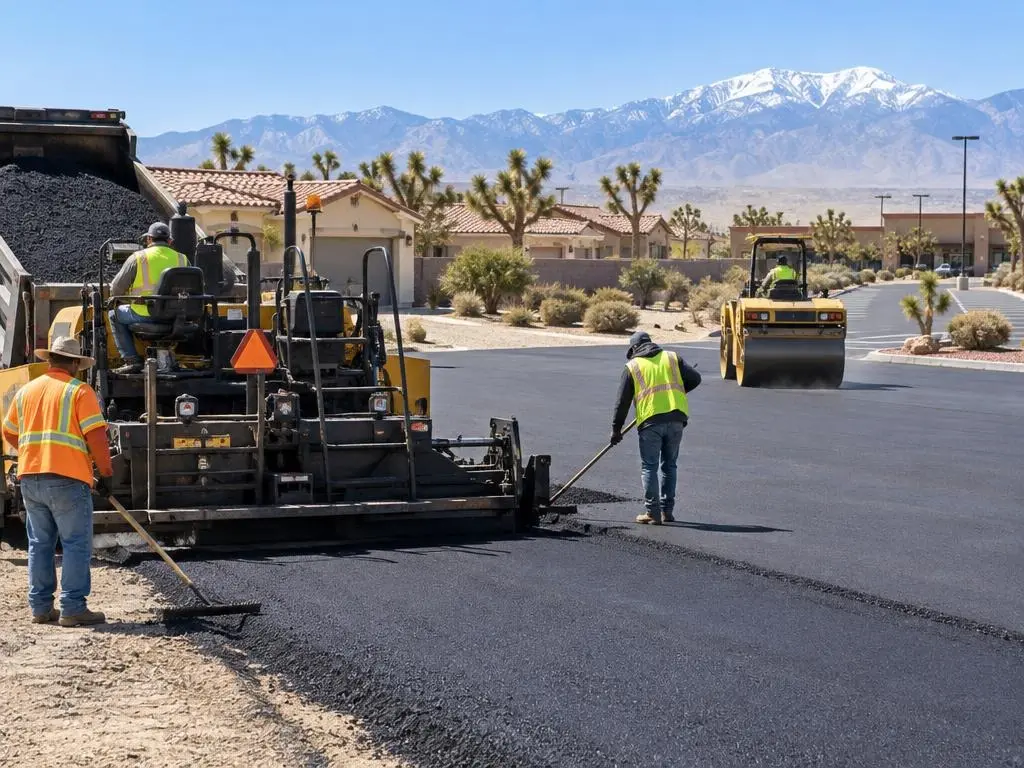
- Placing and rolling hot-mix asphalt to the thickness in your quote
- Finishing edges and transitions so water runs off
- Telling you when to drive on it and when it can be sealed
Asphalt Services in Palmdale
Six services cover asphalt from the day it is placed through the sealing and repair that decide how long it lasts in desert sun.
Asphalt Driveway Paving
New asphalt driveways and gravel-to-asphalt conversions built on a compacted base.
Learn more →Parking Lot Paving
New commercial lots, rebuilt sections and heavy-duty areas for businesses, churches and HOAs.
Learn more →Asphalt Resurfacing & Overlays
A new wearing surface over sound pavement, after cracks and weak spots are repaired.
Learn more →Asphalt Repair & Crack Filling
Pothole repair, patching, crack filling and edge repair before small problems spread.
Learn more →Parking Lot Striping
Stall lines, accessible spaces, fire lanes and arrows laid out and painted.
Learn more →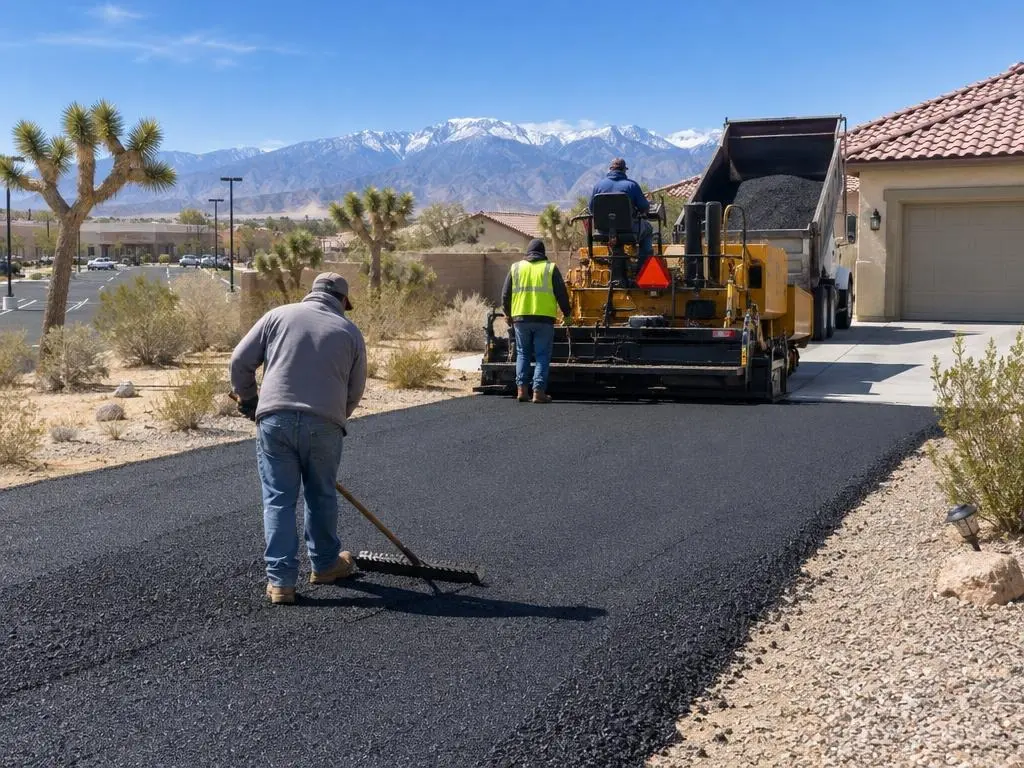
Where We Work
Palmdale is home base. We also work in Lancaster, Quartz Hill, Lake Los Angeles, Littlerock, Sun Village, Pearblossom, Acton, Leona Valley, Agua Dulce and the other communities of the Antelope Valley, plus Rosamond and Mojave across the Kern County line. The valley looks uniform from the freeway, but it is not. Leona Valley and Lake Hughes sit up along the San Andreas Fault at well over 3,000 feet. Lake Los Angeles and Hi Vista are wide, flat desert lots with long driveways. Acton and Agua Dulce are rural canyon communities with equestrian properties. Who issues a permit also changes: the City of Palmdale, the City of Lancaster, Los Angeles County or Kern County, depending on the address. Each town page covers what is specific to that place.
- Asphalt Paving in Palmdale, CA
- Asphalt Paving in Lancaster, CA
- Asphalt Paving in Quartz Hill, CA
- Asphalt Paving in Lake Los Angeles, CA
- Asphalt Paving in Littlerock, CA
- Asphalt Paving in Sun Village, CA
- Asphalt Paving in Pearblossom, CA
- Asphalt Paving in Acton, CA
- Asphalt Paving in Leona Valley, CA
- Asphalt Paving in Agua Dulce, CA
- Asphalt Paving in Desert View Highlands, CA
- Asphalt Paving in Rosamond, CA
- Asphalt Paving in Lake Hughes, CA
- Asphalt Paving in Elizabeth Lake, CA
- Asphalt Paving in Juniper Hills, CA
- Asphalt Paving in Llano, CA
- Asphalt Paving in Antelope Acres, CA
- Asphalt Paving in Green Valley, CA
- Asphalt Paving in Mojave, CA
- Asphalt Paving in Hi Vista, CA
Why Homeowners Call Asphalt Paving Palmdale
Base first
Soft subgrade is dug out and replaced with compacted aggregate before any asphalt goes down.
Thickness in writing
Your quote lists the base depth and the compacted asphalt thickness for every area.
Scheduled around heat and wind
We plan paving and sealing for temperatures and wind that let the material compact and cure properly.
Right agency, up front
We tell you whether the City of Palmdale, LA County or Kern County handles any work at the street.
Common Questions
What is the average price for asphalt paving?
HomeGuide lists standard asphalt driveways at about $5 to $12 or more per square foot installed, and HomeAdvisor lists parking lots at about $2 to $4.50 per square foot. Driveways cost more per foot because they are smaller and need the same equipment and crew. Removal of old pavement, base repair and work at the street add to the total. We give a written price after seeing the site.
How much would a 20x20 asphalt driveway cost?
A 20 by 20 foot driveway is 400 square feet. HomeGuide's size table puts that at about $2,000 to $4,800 for standard asphalt, and notes that some contractors have a minimum charge of $2,000 or more. Tear-out of an old surface or soft-ground repairs would be extra.
How much does a 2,000 square foot asphalt driveway cost?
Using HomeGuide's $5 to $12 per square foot range, 2,000 square feet works out to roughly $10,000 to $24,000. Long driveways on larger Antelope Valley lots often land toward the lower end per foot because the crew and equipment are spread over more area. The base condition and how much grading is needed decide where in that range a job falls.
Is 2 inches of asphalt enough for a driveway?
For cars only, 2 to 3 inches of compacted asphalt over 6 to 8 inches of compacted gravel base is a common residential build. If you park a pickup with a trailer, an RV or a work truck on it, 3 to 4 inches over a deeper base is the safer choice. Two inches on a weak base will crack no matter how well it is laid.
When is the right time of year to pave in Palmdale?
Spring and fall are the easiest, but we pave most of the year. In summer we avoid placing and sealing in the hottest part of the afternoon so the surface is not marked up before it cools. In winter we wait for ground temperatures that let the mix compact, since Palmdale averages about 52 freezing mornings a year.
How soon can I seal a new asphalt driveway?
HomeGuide recommends waiting 3 to 6 months after paving so the asphalt can cure. In the desert, the first seal coat is worth doing on time, because sun and heat start drying out the binder from the first summer.
Do I need a permit to pave my driveway in Palmdale?
Paving that stays on your side of the property line usually does not involve the street. Work on the driveway approach, curb or sidewalk is in the public right-of-way, and Palmdale's code adopts Los Angeles County's highway permit ordinance for that work. We confirm the current requirements for your address before any approach work is scheduled.
Get an Asphalt Paving Estimate
Free on-site estimates in Palmdale and across the Antelope Valley.